Learning to Sail. What to Expect
There is a particular kind of freedom that comes from steering a sailboat.
You have the sea, the wind, a glass of something cold, perhaps a few friends scattered around the deck, and absolutely no idea what the docking is going to be like. This is my definition of happiness.
For years, that was more or less my relationship with the sea: I liked watching waves. I liked being on the water. I liked being by the seashore - rather than in cities. Then we decided to find out what happens when you lear to sail.
Why We Chose Turkey to Learn to Sail
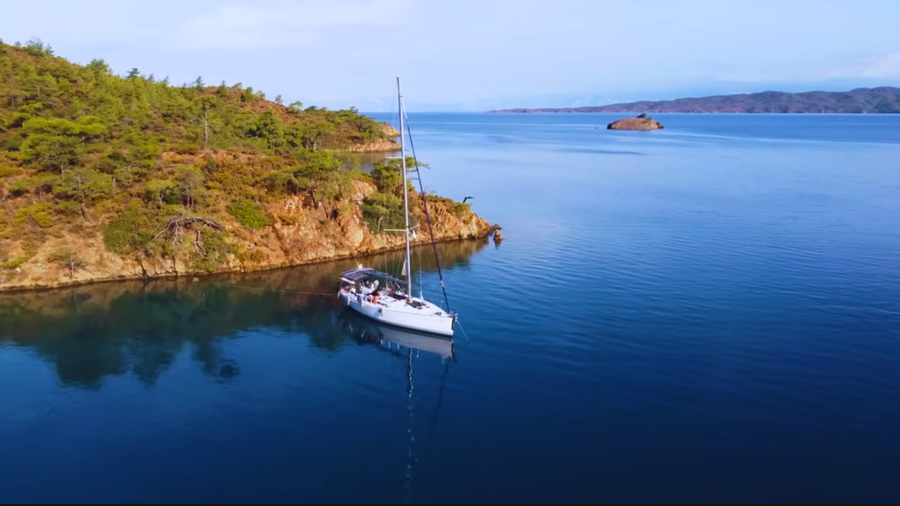
We went to Turkey partly because of the sailing, but also because the coastline itself is extraordinary. The Aegean and Mediterranean meet in a landscape of pine-covered mountains, little coves, clear water and ancient ruins scattered around the shore as if somebody had been careless with history. And it is not quite expensive.
We deliberately went off season. This is becoming a bit of a pattern with us. We would rather have slightly unpredictable weather and empty places than arrive in August and spend our holiday surrounded by 100 sailboats and crowds.Outside the main summer season, the Turkish coast felt wonderfully spacious. There were days when we would sail into a bay and it seemed almost indecently beautiful to have so much of it to ourselves.
Can You Really Learn to Sail in Two Weeks?
This was probably the first question we had before booking the course.
The answer, at least for the intensive skipper course we took, was yes — although “learn to sail” and “become an experienced sailor” are obviously two very different things.
We did a two-week intensive course aimed at qualifying us as skippers. Our schedule was roughly an hour and a half of theory and a couple of hours of sailing practice each day, with the exact rhythm changing according to what we were doing and the weather.
There was a new skipper responsible for leaving the harbour and bringing the boat back in. Everyone else practised the different jobs and manoeuvres. So you didn't spend two weeks sitting at the back while the instructor did everything. Which was probably the whole point.
How Difficult Is the Sailing Licence Exam?
I had imagined the exam would be one of those mildly ceremonial things where everybody turns up, fills in a few forms, demonstrates that they know what a rope is and is then congratulated on becoming Captain. We were told that roughly one person in ten fails, which was enough to make the whole thing feel considerably more real.
By the end, the boat had stopped feeling like a complicated floating machine and started feeling like something you could actually understand with a bit more practice.
The Strange Pleasure of Steering Your Own Boat
For me, the best part was being on the deck with a beautiful view in every weather. And especially, it was steering. There is something almost primitive about it: Odysseus sailed to Troy and back home some thousands of years ago.
You are in the moment. You feel the wind against your face, watch the sails, feel the boat respond underneath you and gradually start understanding that you are not merely travelling through the landscape — you are interacting with it. On a road, you point the car towards a destination and the engine does the rest. On a boat, the relationship between wind, sail, rudder and water is much more immediate.
Some people love sailing because it gives them the perfect setting for dinner with friends on a beautiful yacht or doing tavern-hopping. We discovered that we were considerably more interested in what was happening with the boat.
Give us the steering wheel and leave the dinner for later.
Our Favourite Part Was the Man Overboard Drill
Unexpectedly, one of my favourite parts of the course was practising the man-overboard procedure. Not because we particularly enjoyed imagining somebody falling into the sea, obviously, but because it was the moment when sailing stopped feeling theoretical. Suddenly everyone had a role, and the boat had to be quickly handled as a team.
That stayed with me much more than memorising nautical terminology.
Can You Work Remotely From a Sailboat?
This was another question I kept wondering about before we went.
The answer is: sometimes, yes. But I wouldn't confuse “possible” with “convenient”.During our course, there were still chunks of the day when you could work online. You had limited periods of theory and practical sailing rather than being occupied every waking minute. The problem was the internet.
Once you start moving around the coast, connectivity becomes less predictable. For someone whose work can be done asynchronously and who doesn't need to spend six hours a day on video calls, sailing and remote work can potentially coexist.
Our Sailboat
Is Sailing Expensive?
Yes. There is no point pretending otherwise.
Learning to sail, taking a skipper course, chartering boats, maintaining a boat and keeping it somewhere sensible all add up rather quickly.
And then there is the particularly dangerous sentence:
“We had an accident.”
The costs can quickly pile up.
Only if you consider living full-time on a sailing board, buy one and figure out how to keep costs low, it gets more reasonable. But don't buy a sailing boat if you plan to use it only once or twice a year; just charter one.
Can You Find Cheap Used Sailboats?
Yes, although “cheap boat” and “cheap sailing” are not necessarily synonyms.
There is a substantial second-hand boat market in northern Europe, and Norway is particularly interesting if you are willing to look beyond the glossy Mediterranean charter world. Norwegian marketplaces such as FINN currently have thousands of boats listed, including a large second-hand market.
The boat itself may be surprisingly affordable. The expensive part can begin afterwards: marina fees, maintenance, insurance, equipment, repairs and all the small things that apparently need replacing on boats for reasons that become obvious only after you have bought one.
Catamaran or Monohull for Beginners?
Our course made me understand why catamarans are so attractive for beginners and for people who want to spend longer periods aboard.
There is simply more space.
They are generally stable, the living areas are generous, and the whole thing feels rather more like a floating apartment than a particularly ambitious camping trip.
The downside is obvious once you see one manoeuvring into a marina: they are big.
I suspect the best first boat is not necessarily the most comfortable one. It may be the smallest boat that still allows you to learn properly without feeling overwhelmed and fearful of crashing into dock.
And Then There Is the Atlantic
There is a whole world of sailors looking for crew for longer passages, including Atlantic crossings. Current crew networks such as Find a Crew connect boat owners and potential crew internationally, while specialist offshore communities and sailing rallies also advertise passage opportunities.
Instead of buying the ticket, you become part of the journey.
Friends Who Made Us Want to Go Further
We have friends who have done exactly this — joining boats for passages, spending weeks at sea, moving between countries by water rather than flying between them.Their stories are never particularly polished.
There are stories about sleeping badly, fixing things that broke at inconvenient moments, arriving somewhere exhausted, and discovering that the peaceful anchorage you had been dreaming about was considerably less quiet once the wind changed direction at 3 a.m.
But there are also stories about waking up offshore with nothing around you, arriving at islands you would never have visited otherwise, and becoming completely absorbed in the little society that develops among sailors in a random port.
And perhaps that is the real attraction of learning to sail.
It isn't the yacht lifestyle, at least not for me.
For somebody who has spent years moving around the world by plane, train, car, bus and horse, that feels like learning an entirely new vocabulary for movement.
menu_book Continue reading